Key Takeaways
- Many early science difficulties in kindergarten come from language, observation, and routine, not from a lack of ability.
- Your child may need extra modeling to sort, compare, describe change, and explain what they notice during simple science activities.
- Hands-on practice, teacher feedback, and one-on-one support can help young learners connect science words to real experiences.
- When support is personalized, kindergarten students often build confidence in science along with stronger listening, speaking, and thinking skills.
Definitions
Science foundations are the early skills children use to observe, ask questions, describe objects, notice patterns, and talk about how the world works.
Guided practice means an adult helps a child work through a task step by step, offering prompts, examples, and feedback until the child can do more independently.
Why kindergarten science can feel harder than it looks
To adults, kindergarten science often looks simple. Children may sort leaves, talk about weather, compare living and nonliving things, or observe what sinks and floats. But these activities ask young learners to do several things at once. Your child may need to listen closely, follow directions, use new vocabulary, make observations, and explain thinking out loud. That is a lot for a 5- or 6-year-old.
When parents search for where kindergarteners struggle with science foundations, they are often noticing something real but easy to misread. A child who seems uninterested in science may actually be unsure how to describe what they see. A child who gives one-word answers may understand more than they can say. Another child may enjoy experiments but get confused when the class moves from touching and watching to sorting, predicting, or explaining.
In many classrooms, kindergarten science is woven into reading, speaking, drawing, and early math. A lesson on animal needs may also require your child to listen to a read-aloud, identify picture details, compare habitats, and use words like shelter, food, and water correctly. Teachers know these lessons build important early academic habits. That is one reason science challenges at this age are often connected to communication and developmental readiness as much as content knowledge.
Educationally, this is very typical. Young children learn best through repetition, concrete examples, and adult language models. If your child needs more time, more demonstrations, or more chances to practice, that is not unusual. It is part of how early science learning develops.
Where elementary students in kindergarten science often get stuck
One common challenge is observation. In kindergarten science, teachers often ask students to look carefully and notice details. That sounds straightforward, but many children are still learning the difference between looking and observing. For example, during a plant lesson, a teacher may ask, “What changed since yesterday?” Your child might say, “It got bigger,” but miss details like a new leaf, a drooping stem, or drier soil. Observation requires attention, memory, and language all working together.
Another frequent sticking point is sorting and classifying. A class may sort objects by texture, size, material, or whether they are living or nonliving. Some children understand the idea when there is one obvious rule. They may struggle when there are several possible ways to sort. If your child groups a rock and a toy car together because both are gray, but the class is sorting by living versus nonliving, the issue may be about understanding the task, not the science idea itself.
Cause and effect can also be tricky. Kindergarten science introduces simple relationships such as sunlight helps plants grow, ice melts when it gets warmer, or pushing harder makes a toy car move faster. Young children often notice the exciting part of an activity but not the reason behind it. In a sink-or-float lesson, for instance, your child may remember that the orange floated and the coin sank, but not yet understand how to compare results or talk about what happened across several objects.
Vocabulary is another major factor. Science uses words that may not come up often at home, including observe, predict, compare, habitat, weather, motion, and change. A child may understand an idea during hands-on work and still struggle when the teacher asks a question using unfamiliar terms. That is why teachers often repeat words, use pictures, and ask students to say ideas in complete sentences.
Parents also notice difficulty with multi-step directions. A teacher might say, “First draw the weather, then circle the cloud type, and finally tell your partner what you notice.” If your child only completes the first step, that may affect science performance even when the concept is within reach. For some families, resources about focus and attention can help explain why classroom routines sometimes affect learning in content areas like science.
These patterns are part of where kindergarteners struggle with science foundations in real classrooms. The work is not just about facts. It is about learning how to think, notice, and communicate in age-appropriate ways.
Science learning patterns parents often notice at home
At home, science struggles can show up in subtle ways. Your child may love nature walks but have trouble answering questions like, “How are these two leaves different?” They may enjoy talking about rain, snow, or bugs, yet become quiet when asked to explain why something happened. Some children rush through science worksheets because drawing and labeling feel harder than the actual idea.
You might also see uneven performance. A child may do well during a hands-on class activity and then seem lost on a simple follow-up page. This happens because kindergarten science often shifts between concrete experience and symbolic representation. Looking at magnets is different from circling pictures of magnetic objects on paper. Watching a caterpillar is different from sequencing its life cycle cards in order. When the task becomes more language-based or abstract, some children need extra support.
Another common pattern is memorizing without understanding. Your child might repeat that plants need sun and water, but when looking at two classroom plants, they may not connect drooping leaves to a lack of water. In early science, true understanding grows when children repeatedly connect words, pictures, and real examples. That connection does not always happen right away.
Parents sometimes notice frustration during school conversations. If you ask, “What did you learn in science today?” and your child says, “I don’t know,” it may not mean nothing was learned. Kindergarten students often need more specific prompts. Questions like “Did you look at weather, animals, or plants today?” or “What did you touch or test?” can help them retrieve the experience and talk about it.
Teacher feedback matters a great deal here. In strong kindergarten classrooms, teachers model how to answer, how to compare, and how to use evidence from what students saw. A teacher might say, “I noticed the ice cube is smaller now. That tells me it is melting.” This kind of language modeling is academically important because children learn science talk by hearing and practicing it many times.

What helps when your child needs more guided science support?
The most effective support is usually concrete, short, and interactive. Young children rarely benefit from long explanations about science concepts. They learn more from doing, noticing, and talking with an adult. If your child is learning about weather, for example, you can step outside together, look at the sky, feel the air, and ask simple questions such as, “Is it sunny or cloudy?” “What do you feel on your skin?” and “What should we wear today?” That turns science into an observable routine.
For children who struggle with vocabulary, use the same words their teacher is likely using in class. Instead of only saying, “Look at that,” try, “Let’s observe,” or “Can you compare these two rocks?” Repetition in context helps children connect academic words to actions. In kindergarten, that connection is often more important than formal definitions.
Drawing can also support understanding, especially when speaking is hard. After a simple activity, ask your child to draw what happened first and what happened next. In a plant unit, they might draw a seed, a sprout, and a taller plant. Then you can help them add a few labels or describe each picture aloud. This kind of guided retelling strengthens both science understanding and expressive language.
Sorting games are especially useful because classification is a core kindergarten science skill. You can sort buttons by color, leaves by shape, or household items by material. The key is to ask your child to explain the rule. If they can sort but cannot say why, they may still need support with the thinking language behind the task.
Prediction practice helps too. Before dropping objects in water, ask, “What do you think will happen?” Afterward, ask, “What happened?” and “Was your prediction the same or different?” These simple routines teach your child that science includes wondering, testing, and revising ideas. That is a foundational habit of mind, even in kindergarten.
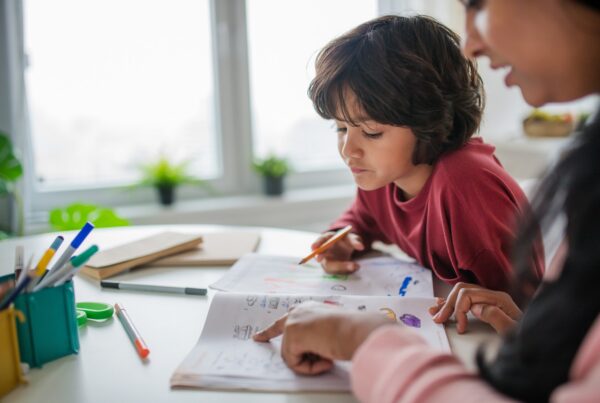
If your child becomes overwhelmed, shorter one-on-one practice can make a big difference. Individualized support allows an adult to slow the pace, repeat directions, and adjust language. A tutor or other skilled educator can notice whether the main issue is vocabulary, attention, expressive language, concept confusion, or task completion. That kind of targeted feedback is often what helps early learners move from participation to understanding.
When extra instruction makes a meaningful difference in science
Some children simply need more chances to practice than a busy classroom can provide. That is especially true in kindergarten, where developmental differences are wide. One child may be ready to explain patterns in weather with ease, while another is still learning how to answer a question in a full sentence. Both can make progress, but they may need different levels of support.
Additional instruction can be especially helpful if your child often misinterprets science directions, struggles to explain observations, or avoids science tasks that involve speaking, drawing, or comparing. In these situations, the goal is not to push harder. It is to make the learning clearer. A supportive adult can break a lesson into smaller parts, model the expected language, and give immediate feedback.
For example, if your child is learning about living and nonliving things, guided instruction might begin with real objects and pictures. The adult can ask, “Does it grow? Does it need food or water?” Then your child can practice sorting with support before trying the same idea on a worksheet. This gradual release is grounded in how young children typically learn. They move from concrete experience to supported language to more independent application.
Tutoring can also help children who are curious but inconsistent. Some kindergarten students ask wonderful questions yet have trouble staying with a task long enough to record, compare, or explain. In one-on-one sessions, a tutor can build routines that match the child’s pace and attention span. That may include shorter tasks, visual supports, repeated sentence frames, or immediate correction in a calm setting.
K12 Tutoring approaches this kind of support as part of normal academic development. For a young student, success in science is not about memorizing advanced facts. It is about building the early habits that science depends on, including noticing details, using words carefully, and learning from guided feedback. When those skills are supported early, children often become more confident across other school subjects too.
Signs your child is building stronger science foundations
Progress in kindergarten science may look small from week to week, but it is often meaningful. Your child may start using words like predict, observe, and compare more naturally. They may begin noticing details on their own, such as a shadow changing shape or a plant leaning toward light. They may also become more willing to answer science questions, even if the answers are still simple.
Another good sign is improved explanation. Instead of saying only “It changed,” your child might say, “The puddle got smaller because the sun came out,” or “This one is living because it grows.” These early explanations show that your child is connecting observations to ideas. That is a major step in science learning.
You may also notice better stamina during class-related tasks. A child who once resisted drawing and labeling may complete a simple science journal page with less frustration. A child who guessed randomly during sorting may start checking the rule first. These are important signs of growth because they reflect stronger thinking habits, not just correct answers.
Most importantly, confidence often grows alongside understanding. When children experience success with supported practice, they are more likely to stay engaged, take risks, and recover from mistakes. That matters in science, where curiosity and revision are part of the learning process.
Tutoring Support
If your child is showing some of the common patterns described above, extra support can be a practical and encouraging next step. K12 Tutoring works with families to provide individualized instruction that matches a young learner’s pace, language development, and classroom expectations. In kindergarten science, that may mean helping a child practice observation, vocabulary, sorting, prediction, and explanation through guided, age-appropriate activities. With steady feedback and one-on-one attention, many children become more confident and more independent in how they approach science learning.
Related Resources
- How To Build Your Child’s Confidence: A Parent’s Guide – Crimson Rise
- How High-Quality, Small-Group Tutoring Can Accelerate Learning – IES (U.S. Department of Education)
- Roles in Gifted Education: A Parent’s Guide – davidsongifted.org
Trust & Transparency Statement
Last reviewed: May 2026
This article was prepared by the K12 Tutoring education team, dedicated to helping students succeed with personalized learning support and expert guidance. K12 Tutoring content is reviewed periodically by education specialists to reflect current best practices and family feedback. Have ideas or success stories to share? Email us at [email protected].