Learning Spanish is an exciting adventure, but every new skill comes with its tricky moments. If you’ve started diving into Spanish grammar, you’ve likely encountered the infamous pair of prepositions, para and por. While both translate to “for” in English, they’re far from interchangeable. Mastering the difference between para and por is a key step to sounding like a natural Spanish speaker. Don’t worry—this guide will break it all down into simple explanations, examples, and tips to make it easier.
Why Are Para and Por Important?
Prepositions play a crucial role in any language because they connect ideas and clarify meaning. Getting your prepositions wrong can confuse your listener or completely change the meaning of your sentence. Imagine saying “a gift for Maria” versus “a gift by Maria”—a small switch, but it changes everything! That’s why understanding para vs. por is essential to communicating with confidence in Spanish.
Now, let’s take a closer look at these two prepositions and learn when to use each.
Understanding Para
Think of para as pointing toward a purpose or destination. It’s forward-looking, often signaling intent, goals, or direction.
Primary Uses of Para
Here are the main contexts where para is used:
- Destination or Direction
Indicates where someone or something is heading.
Example: Salimos para Madrid.
(We’re leaving for Madrid.) - Recipient
Shows who benefits from something or who it’s intended for.
Example: Este regalo es para ti.
(This gift is for you.) - Purpose or Goal
Explains the reason for doing or using something.
Example: Necesito gafas para leer.
(I need glasses to read.) - Deadline or Specific Time
Refers to a future point in time by which something will happen.
Example: La tarea es para mañana.
(The assignment is for tomorrow.) - Comparison or Opinion
Expresses a judgment or a point of view.
Example: Para ser tan joven, es muy maduro.
(For being so young, he is very mature.)
Quick Tip to Remember Para
Use para when you’re thinking about the destination—whether that’s literal (a place) or figurative (a goal).
Understanding Por
Por is more about cause, movement, and means. It often describes the “how” or the “why” behind an action.
Primary Uses of Por
Here’s when you’ll typically choose por:
- Reason or Cause
Explains why something happened.
Example: Lo hago por ti.
(I do it because of you.) - Duration of Time
Indicates how long something lasts.
Example: Estudié por tres horas.
(I studied for three hours.) - Exchange or Substitution
Used when referring to trade or replacement.
Example: Te doy mi sándwich por tu manzana.
(I’ll give you my sandwich for your apple.) - Means of Communication or Transportation
Tells how something is done or how someone travels.
Example: Hablamos por teléfono.
(We talked over the phone.)
Example: Viajé por avión.
(I traveled by plane.) - Movement Through a Space
Describes going through a location.
Example: Caminamos por el parque.
(We walked through the park.) - Expressions
Often appears in idiomatic phrases.
Example: Por supuesto.
(Of course.)
Example: Por favor.
(Please.)
Quick Tip to Remember Por
Use por when thinking about reasons, exchanges, or movement.
Key Differences Between Para and Por
Understanding the context is everything when deciding whether to use para or por. Below is a handy comparison to make the distinction clearer:
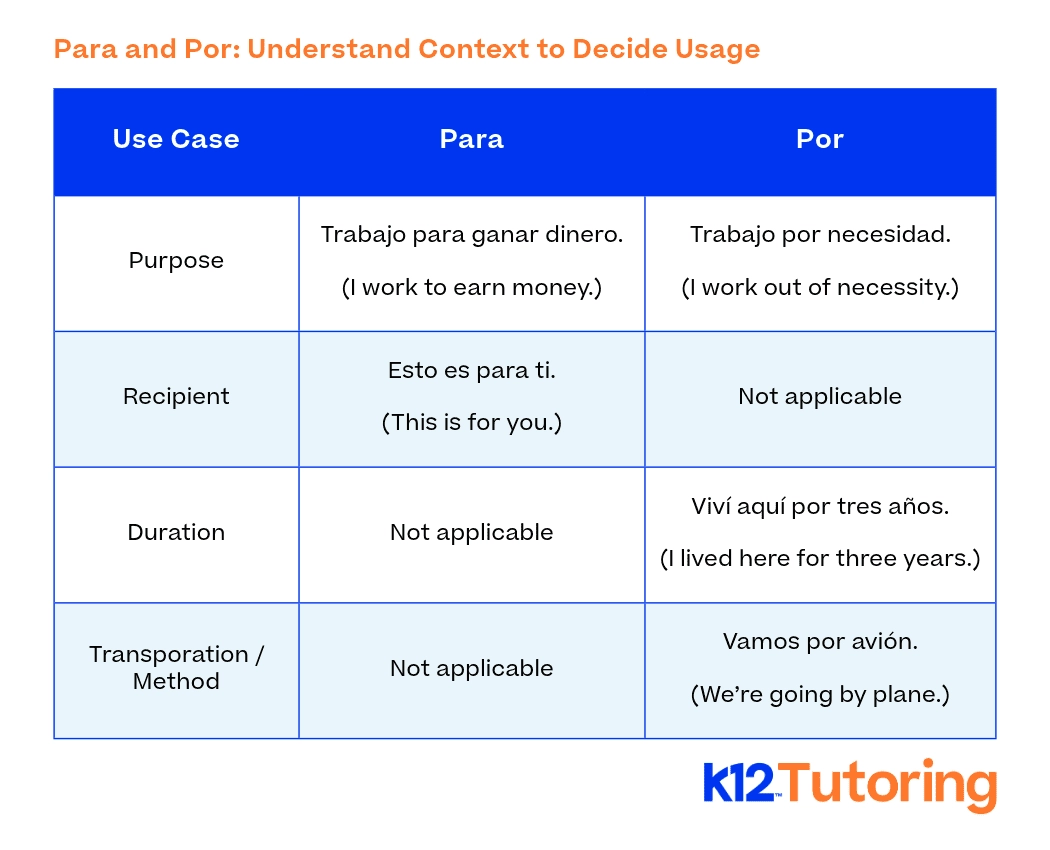
Remember, para gives a sense of forward direction, while por often looks backward to a cause or through movement.
Need Extra Support? Try Personalized Tutoring
If you’re still struggling with mastering Spanish grammar, don’t worry—help is just a click away. At K12 Tutoring, our experienced Spanish Tutors can give you the personalized guidance you need to nail para vs. por and beyond. Whether you’re tackling tricky topics or just want extra practice, our tutors tailor each session to your needs.
Why choose K12 Spanish tutors?
- State-certified and experienced teachers.
- 1-on-1 lessons tailored to your pace and goals.
- Interactive sessions to build fluency and confidence.
Explore K12 Tutoring’s online options for Spanish Tutors to book your session today!
Wrapping Up
Mastering the difference between para and por is an essential step in becoming confident in Spanish. Think of para as pointing to a destination or purpose, and por as telling you why or how something happens. With practice and the right guidance, you’ll be navigating Spanish prepositions like a pro in no time!